I went to see the latest James Bond, Casino Royal tonight. First time in 5 years I went to the cinema by my self. Very nice to spend some time doing something without anyone else.
The film itself was rather good. Of course it only loosely followed the book but hey, that's 53 years old now. What it did have was a lot more feeling of the real James Bond. James is, let face it, just not a very nice guy. Daniel Craig is, in my opinion, possibly the best James Bond since Connery did Dr. No in '63.
Script did keep some of the unexpected changes of direction the book also had. Eva Green playes a nice Vesper Lynn, sexy in a way you wouldn't expect in a major hit film these days. All in all, highly recommended! IMDB gives it a 7.9 which might be the highest rated Bond ever.
Wednesday, January 03, 2007


Tuesday, January 02, 2007
Now why can't I shoot these (yet)
Excellent use of DoF, good light, nice expression. Practice, practice I suppose.

Sunday, December 31, 2006
Happy 2007 to everyone. Over here in the netherlands we always eat oliebollen on new year's eve. Oliebollen:

They are made by using two spoons to scoop a certain amount of dough and dropping the dough into a deep fryer filled with hot oil. This way, a sphere-shaped "oliebol" emerges.
The dough is made from flour, eggs, yeast, some salt, milk and optionally some sultanas or currants and sometimes apple pieces. The dough needs time to rise for at least an hour. Oliebollen are usually served with powdered sugar.
(From:http://en.wikipedia.org/wiki/Oliebollen )Monday, December 25, 2006
Esther enjoying a cup of tea
After christmas dinner. We had Esther's mother and grandmother over. Nice, not too crowded, kids in bed at a decent time. Not bad at all for a christmas dinner.
This year my christmas stollen turned out better than ever. I suspect it did because I bought flour at the old windmill in town. Best flower I've ever baked with.

This year my christmas stollen turned out better than ever. I suspect it did because I bought flour at the old windmill in town. Best flower I've ever baked with.
Wednesday, December 06, 2006
turns out I have a macro lens after all
This was shot with my old 35-70 in macro on manual focus. Crop of a larger pic. I'm stunned by the detail this old lens can produce.
Light from a SB600 on camera and bounced off the wall which it why there's a shadow on the face.

Light from a SB600 on camera and bounced off the wall which it why there's a shadow on the face.
Tuesday, November 21, 2006
2000 page views on my flickr album!
Yes, around 1700 CET my flickr album went trough the 2000 page views. Now if only more people left a comment....
Yes, around 1700 CET my flickr album went trough the 2000 page views. Now if only more people left a comment....
Saturday, November 18, 2006
sinterklaas_klein
It's the time of the year again! Foreigners have a look at: http://en.wikipedia.org/wiki/Sinterklaas

Tuesday, November 14, 2006
Nikon lens compatibility
There's a lot of confusion in forums on this subject. I thought perhaps it would be useful to write something about it. People seem to think that they need a DX lens or that only older lenses with a D on it will work with their new D50/D70/D80
Here's the deal:
Any Autofocus lens will work on your digital body!
There's a few sigma lenses that can cause problems under some conditions, Sigma is aware and fixes the problems. There's also lenses made for the pronea serie, labeled as IX. These turn up at very attractive prices on the second hand market but cannot be used on your Nikon dSLR.
Manual focus lenses will work as long as they're Ai.
Non ai lenses can be converted, see http://www.aiconversions.com/ for information. Mounting an unconverted lens can seriously damage your camera.
However, on anything but the D1, D2 and D200 these will not meter. What does that mean to you? It means you're own your own to get your images properly exposed. You can use a hand-held light meter, you can simply guesstimate and use your histogram but you're own your own!
What AI lenses to avoid?
According to my D50 manual the following lenses should be avoided because they can damage your camera.
Some fisheyes: 6mm f/5.6, 8mm f/8, OP 10mm f5.6
21mm f/4
ED 180-600mm f/8 (serials 174041-174180)
ED 360-1200mm f.11 (serials 174031-174127)
200-600mm f/9.5
Anything made for the F3AF
PC 28mm f/4 (serials below 180900)
PC 35 mm f/3.5
1000mm f.6.3
1000mm f/11 (serials 142361-143000)
2000mm f/11 (serials 200111-200310)
As you can see a lot of rather exotic lenses on this list. If you have a Thom Hogan ebook (which I can recommend, there's also a table in there of what works and what doesn't. If you're happy enough to own a D200 have a look at http://www.nikonians.org/nikon/d200_and_non-cpu_lenses/index.html
There's a lot of confusion in forums on this subject. I thought perhaps it would be useful to write something about it. People seem to think that they need a DX lens or that only older lenses with a D on it will work with their new D50/D70/D80
Here's the deal:
Any Autofocus lens will work on your digital body!
There's a few sigma lenses that can cause problems under some conditions, Sigma is aware and fixes the problems. There's also lenses made for the pronea serie, labeled as IX. These turn up at very attractive prices on the second hand market but cannot be used on your Nikon dSLR.
Manual focus lenses will work as long as they're Ai.
Non ai lenses can be converted, see http://www.aiconversions.com/ for information. Mounting an unconverted lens can seriously damage your camera.
However, on anything but the D1, D2 and D200 these will not meter. What does that mean to you? It means you're own your own to get your images properly exposed. You can use a hand-held light meter, you can simply guesstimate and use your histogram but you're own your own!
What AI lenses to avoid?
According to my D50 manual the following lenses should be avoided because they can damage your camera.
Some fisheyes: 6mm f/5.6, 8mm f/8, OP 10mm f5.6
21mm f/4
ED 180-600mm f/8 (serials 174041-174180)
ED 360-1200mm f.11 (serials 174031-174127)
200-600mm f/9.5
Anything made for the F3AF
PC 28mm f/4 (serials below 180900)
PC 35 mm f/3.5
1000mm f.6.3
1000mm f/11 (serials 142361-143000)
2000mm f/11 (serials 200111-200310)
As you can see a lot of rather exotic lenses on this list. If you have a Thom Hogan ebook (which I can recommend, there's also a table in there of what works and what doesn't. If you're happy enough to own a D200 have a look at http://www.nikonians.org/nikon/d200_and_non-cpu_lenses/index.html
Monday, November 13, 2006
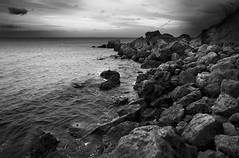
Rocks Rock
Not often you'll see me blog somebody else's photo but with this I just had to. Not only a very good composition but also an excellent B&W conversion.
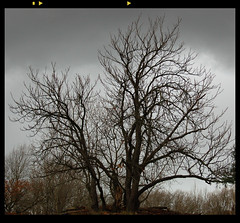
Available light
Is sometimes not much like yesterday at 13.00 when I shot this.
Finally some time for a walk with the family and the weather's like this. Shot about 60 frames and this was the only decent one. I like it, reminds me a bit of the Lord of the Rings films.
Finally some time for a walk with the family and the weather's like this. Shot about 60 frames and this was the only decent one. I like it, reminds me a bit of the Lord of the Rings films.
Does gear matter?
I like to think it doesns't matter as much as skill. I got into a heated discussion over on the dpreview forums over it. A wife was asking the group if a D80 +28-80 +70-300 would make a nice Christmas present for her husband. Now the crop factor makes a 28-80 loose some wide angle but otherwise it isn't a bad lens. A bunch of the lens snobs felt otherwise. Yes, a 18-70 would be nicer but come on, you can still take very good pics with this kit. I got both lenses, the 28-80 is a nice portrait zoom and the 70-300 is nice if you got enough light.
I like to think it doesns't matter as much as skill. I got into a heated discussion over on the dpreview forums over it. A wife was asking the group if a D80 +28-80 +70-300 would make a nice Christmas present for her husband. Now the crop factor makes a 28-80 loose some wide angle but otherwise it isn't a bad lens. A bunch of the lens snobs felt otherwise. Yes, a 18-70 would be nicer but come on, you can still take very good pics with this kit. I got both lenses, the 28-80 is a nice portrait zoom and the 70-300 is nice if you got enough light.
Wednesday, November 08, 2006
Wanted list
Now, what would you buy if you could spend a bundle on Nikon gear? Here's what I'd buy if I won the lottery. :-)
D200
MB-D200 grip
18-135mm f/3.5-5.6 ED-IF AF-S DX Zoom-Nikkor
50mm f/1.4D AF Nikkor
60mm f/2.8D AF Micro-Nikkor
85mm f/1.4D AF Nikkor
180mm f/2.8D ED-IF AF Nikkor
80-400mm f/4.5-5.6D ED VR AF Zoom-Nikkor
An SB-800 or two.
A nice case to put it all in.
Partial donations are of course very welcome.
But seriously, these are nice toys but as long as my son can still shoot this with a cheap-ass 20 year old 35-70, it's not needed to take great photos.

Now, what would you buy if you could spend a bundle on Nikon gear? Here's what I'd buy if I won the lottery. :-)
D200
MB-D200 grip
18-135mm f/3.5-5.6 ED-IF AF-S DX Zoom-Nikkor
50mm f/1.4D AF Nikkor
60mm f/2.8D AF Micro-Nikkor
85mm f/1.4D AF Nikkor
180mm f/2.8D ED-IF AF Nikkor
80-400mm f/4.5-5.6D ED VR AF Zoom-Nikkor
An SB-800 or two.
A nice case to put it all in.
Partial donations are of course very welcome.
But seriously, these are nice toys but as long as my son can still shoot this with a cheap-ass 20 year old 35-70, it's not needed to take great photos.
Thursday, October 26, 2006
My son is a photographic talent
This weekend I lend my D50 to my 4 year old son. This is one of the portraits he did with it. I think the boy has talent!

Tuesday, October 17, 2006
Monday, October 16, 2006
A sunday in Groenendaal parc, I had my Nikon Af 70-300/4.0-5.6 G in the camera bag and this deer (or is it a roebuck?) was lying there just inviting a shot. A lot of people write that the 70-300 g-type is soft at 300mm but I don't find this all that soft. OK, I had the aperture at 7.1 and that tends to help.
For those of you interested in this lens, here's a crop: http://i45.photobucket.com/albums/f81/wijnands/small_deer.jpg

For those of you interested in this lens, here's a crop: http://i45.photobucket.com/albums/f81/wijnands/small_deer.jpg
Wednesday, October 11, 2006
Oops, we accidently deleted an OU
was the title of a high priority call that came in this morning. Now I knew that this client's infrastructure was connected by high-speed links so there was no chance of recovering the OU from a remote domain controller.
Being a MCSE I of course know the text-book solution to this, an authoritve restore and a lot of work with NTDSUtil. Not a job I was in the mood for this morning. So, after alerting the storage group to keep the tapes on hand I started looking for alternatives.
A quick google turned up KB article 840001 which outlines the procedure but I figured that by now there would be alternatives. The client's domain controllers weren't on SP1 yet so method 1 was out.
Reading that did remind me that objects that are deleted from Active Directory are not actually gone. Instead they are marked for deletion (tombstoned) but they are retained in active directory. I also read that it is possible with the LDP utility (ldp.exe from the support tools) to restore these objects. However using LDP for this is a rather time consuming process because you're manually editing properties for each object. So I figured someone else must have come across this already and that person would probably have written a clever little script for this tedious task.
Some more googling and I came across ADrestore from sysinternals. Now every admin knows that sysinternals makes excellent freeware so I figured I'd give that a shot.
Fired it up with adrestore -r laptops to restore the OU that was missing. OU restored in 3 seconds! Looked good so I did an adrestore -r nl-ams-lt to start restoring the computer accounts that were in the deleted ou. No luck! All the records had their LastKnownParent set to the Deleted Objects context.
Back to google and I quickly found Quest Software's Object Restore for Active Directory (registration required) which is a tool that does more or less the same only with a GUI. I noticed that the laptops OU was still listed as deleted. I restored it with that tool and tried to restore the computer accounts. Object restore crashed on me! So back to the command line and adrestore. This time the adrestore -r nl-ams-lt listed a lot of laptops with the correct lastKnownParent. Bingo! I quickly restored the 94 computer accounts and activated them.
Writing this I suspect that the admin who deleted the OU in the first place probably tried to save something by recreating the OU and that I restored that empty OU first.
Conclusion, to recover from an "oops" situation there are other options than booting in restore mode and messing with NTDSUtil.
Edit: This whole process would have worked a lot better if I'd remembered that unless you're in AD restore mode you can't restore passwords. So I had the computer accounts back but no passwords. Took a lot of tedious work with authorive restores to get that sorted.
The process I described here worked for me, however it may not work for you. Therefore this information is provided "as-is" with no warranty whatsoever. When working with Active Directory at this level the potential to do serious damage is great so be carefull and consider getting someone who knows what he/she is doing to assist you!
was the title of a high priority call that came in this morning. Now I knew that this client's infrastructure was connected by high-speed links so there was no chance of recovering the OU from a remote domain controller.
Being a MCSE I of course know the text-book solution to this, an authoritve restore and a lot of work with NTDSUtil. Not a job I was in the mood for this morning. So, after alerting the storage group to keep the tapes on hand I started looking for alternatives.
A quick google turned up KB article 840001 which outlines the procedure but I figured that by now there would be alternatives. The client's domain controllers weren't on SP1 yet so method 1 was out.
Reading that did remind me that objects that are deleted from Active Directory are not actually gone. Instead they are marked for deletion (tombstoned) but they are retained in active directory. I also read that it is possible with the LDP utility (ldp.exe from the support tools) to restore these objects. However using LDP for this is a rather time consuming process because you're manually editing properties for each object. So I figured someone else must have come across this already and that person would probably have written a clever little script for this tedious task.
Some more googling and I came across ADrestore from sysinternals. Now every admin knows that sysinternals makes excellent freeware so I figured I'd give that a shot.
Fired it up with adrestore -r laptops to restore the OU that was missing. OU restored in 3 seconds! Looked good so I did an adrestore -r nl-ams-lt to start restoring the computer accounts that were in the deleted ou. No luck! All the records had their LastKnownParent set to the Deleted Objects context.
Back to google and I quickly found Quest Software's Object Restore for Active Directory (registration required) which is a tool that does more or less the same only with a GUI. I noticed that the laptops OU was still listed as deleted. I restored it with that tool and tried to restore the computer accounts. Object restore crashed on me! So back to the command line and adrestore. This time the adrestore -r nl-ams-lt listed a lot of laptops with the correct lastKnownParent. Bingo! I quickly restored the 94 computer accounts and activated them.
Writing this I suspect that the admin who deleted the OU in the first place probably tried to save something by recreating the OU and that I restored that empty OU first.
Conclusion, to recover from an "oops" situation there are other options than booting in restore mode and messing with NTDSUtil.
Edit: This whole process would have worked a lot better if I'd remembered that unless you're in AD restore mode you can't restore passwords. So I had the computer accounts back but no passwords. Took a lot of tedious work with authorive restores to get that sorted.
The process I described here worked for me, however it may not work for you. Therefore this information is provided "as-is" with no warranty whatsoever. When working with Active Directory at this level the potential to do serious damage is great so be carefull and consider getting someone who knows what he/she is doing to assist you!
Monday, October 09, 2006
Manual Focus lens on a D50
Trickier than I thought. You're totally on your own, no metering, just the little green focus dot and that's not always correct.
Thanks to my years of experience with the Zenith EM I was able to get decent exposure after just a few shots. Took some more tries to get something decent. This was shot #21 with a 28-85mm f/3.5-4.5 AIS Manual Focus Lens I borrowed from a friend.
Lens does have a nice weight to it, about 450 grams which is heavier than my 70-300. Focussing is tricky, the area of the focus screen you need the most is taken up by the AF points. All in all a nice experience though. Should I happen to find a nice manual focus micro such as the 105mm for a decent price I'd be very tempted. This is the lens I used:

Thanks to my years of experience with the Zenith EM I was able to get decent exposure after just a few shots. Took some more tries to get something decent. This was shot #21 with a 28-85mm f/3.5-4.5 AIS Manual Focus Lens I borrowed from a friend.
Lens does have a nice weight to it, about 450 grams which is heavier than my 70-300. Focussing is tricky, the area of the focus screen you need the most is taken up by the AF points. All in all a nice experience though. Should I happen to find a nice manual focus micro such as the 105mm for a decent price I'd be very tempted. This is the lens I used:

Friday, October 06, 2006
Photography
I started out on this hobby in the mid-80s. At that time I was really into planes and airshow and wanted to shoot pictures of that. After a very brief stint with a compact camera I saved some money from my newspaper round and bought myself a Zenith EM. Light meter above the lens and shutter times of only 1/500 but it takes M42 screw mount lenses. Back in the day there was a large supply of used lenses for decent prices. Good camera, I still have it and I can still shoot very decent pictures with it without consulting the built-in meter. Built like a tank too! I dropped it once and the only damage was to my foot which was between the camera and the floor.
Only drawback was the long time it took to change screw mount lenses. So I bought a Minolta, first an XG-1 and later an XG-9. Nice cameras and they performed well at airshows but I was always struggling to avoid over exposure. Sold the Xg-1 to my dad and recently sold the XG-9. Never did form any attachment to those.
Late 2000 I came across a hardly used Nikon F60 with an 28-80 for a very decent price so I bought that. Good camera, only the built-in flash was overly harsh. With that my love for Nikon really start. The built quality and ergonomics were so very good!
Around 2004 when my kids were toddlers I switched to digital. Digital cameras were rapidly getting better and cheaper and so I bought a Fuji A203. Very nice, very versatile, very bad shutter lag! Still I've captured some nice moments with it.
At that time dSLRs were becomming very nice and still very expensive. It wasn't untill the D50 and the Eos 350 (Rebel to the americans) were on the market that I could even begin to consider owning one.
This summer I got some lucky breaks and after long discussions with my wife I could actually go and get me one.
My Nikon D50!

I bought it, in black of course, with the 18-55DX kit lens. I still had the 28-80 d-type and that worked really well. After a trip to Blijdorp Zoo in Rotterdam I felt the need for a telezoom. I quickly bought a used Sigma 70-210 and almost as quickly regretted it. Fine lens but we never agreed. Just sold it via ebay and bought for only 90 euros an F55 with an 28-80 G-type and a 70-300G lens. Sold the body and the wide angle for 60, got another 30 for the Sigma so for the 80 euros I originally paid for the Sigma I now have a 70-300G type. Much better for me.
When you buy a nice camera like this and you start getting involved in Nikon forums it's easy to be overcome with "lens lust". I'm trying to resist that. Have to remind myself that I'm nowhere near the limits of my current selection of gear. My next goals are working on my post processing (or PP) skills and see what the manual focus lenses a friend will lend me will do on the camera.
I started out on this hobby in the mid-80s. At that time I was really into planes and airshow and wanted to shoot pictures of that. After a very brief stint with a compact camera I saved some money from my newspaper round and bought myself a Zenith EM. Light meter above the lens and shutter times of only 1/500 but it takes M42 screw mount lenses. Back in the day there was a large supply of used lenses for decent prices. Good camera, I still have it and I can still shoot very decent pictures with it without consulting the built-in meter. Built like a tank too! I dropped it once and the only damage was to my foot which was between the camera and the floor.
Only drawback was the long time it took to change screw mount lenses. So I bought a Minolta, first an XG-1 and later an XG-9. Nice cameras and they performed well at airshows but I was always struggling to avoid over exposure. Sold the Xg-1 to my dad and recently sold the XG-9. Never did form any attachment to those.
Late 2000 I came across a hardly used Nikon F60 with an 28-80 for a very decent price so I bought that. Good camera, only the built-in flash was overly harsh. With that my love for Nikon really start. The built quality and ergonomics were so very good!
Around 2004 when my kids were toddlers I switched to digital. Digital cameras were rapidly getting better and cheaper and so I bought a Fuji A203. Very nice, very versatile, very bad shutter lag! Still I've captured some nice moments with it.
At that time dSLRs were becomming very nice and still very expensive. It wasn't untill the D50 and the Eos 350 (Rebel to the americans) were on the market that I could even begin to consider owning one.
This summer I got some lucky breaks and after long discussions with my wife I could actually go and get me one.
My Nikon D50!
I bought it, in black of course, with the 18-55DX kit lens. I still had the 28-80 d-type and that worked really well. After a trip to Blijdorp Zoo in Rotterdam I felt the need for a telezoom. I quickly bought a used Sigma 70-210 and almost as quickly regretted it. Fine lens but we never agreed. Just sold it via ebay and bought for only 90 euros an F55 with an 28-80 G-type and a 70-300G lens. Sold the body and the wide angle for 60, got another 30 for the Sigma so for the 80 euros I originally paid for the Sigma I now have a 70-300G type. Much better for me.
When you buy a nice camera like this and you start getting involved in Nikon forums it's easy to be overcome with "lens lust". I'm trying to resist that. Have to remind myself that I'm nowhere near the limits of my current selection of gear. My next goals are working on my post processing (or PP) skills and see what the manual focus lenses a friend will lend me will do on the camera.
Thursday, October 05, 2006

Tuesday, October 03, 2006
MCSE!!!!
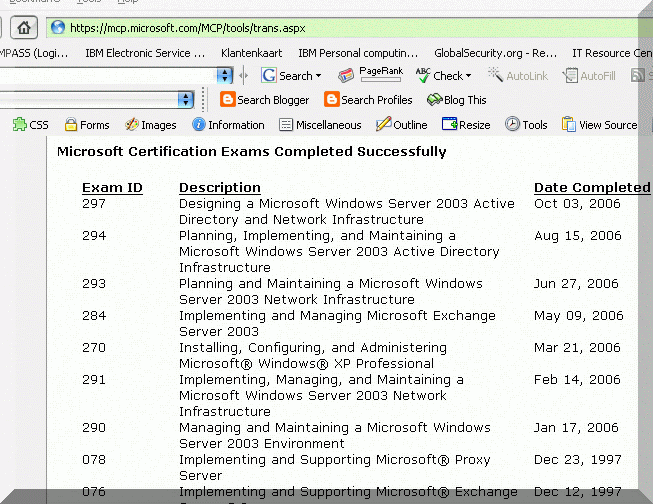
Yep, I finally made it. This morning I sat and passed 70-297, Designing a Microsoft Windows Server 2003 Active Directory and Network Infrastructure. With the help of the self-paced training kit and a transcender CD I prepared for this exam.
During preparation I noticed that you shouldn't be fooled by the thin book. This exam requires knowledge from most of the previous exams (excluding XP and Exchange).
The form of the exam is a bit different that the previous exams. You get four scenarios with 10 questions each. The scenarios contain information about a company that will upgrade or migrate it's current IT infrastructure. To make it a bit more difficult the information you need is fragmented troughout business drivers, interviews, goals etc.
I've found that it helps to scroll trough all the question before moving to the next scenario. Most of the questions and answers have some relation with eachother.
It's difficult to give a study list for this one. You really need to know where to place things like WINS, DNS, DHCP, Domain controllers, VPN, etc, etc givven a certain set of variables.
One thing I'd suggest you memorize is what features the various domain levels bring (mixed mode, native mode, etc) and the differences feature wise between 2000 and 2003. When studying this focus on the administration parts of the differences.
Another suggestion, don't rely on this training kit alone for DNS. Go back to the other book and know exactly what's what with DNS!
Also make sure you know what a Windows 98 and NT client cannot do and a Windows 2000 or XP pro client can.
The transcender CD was useful to get used to the different exam style. In this exam it was more annoying than ever that the testing software doesn't support the scroll wheel on the mouse because you have a lot of reading to do.
For those of you who aren't as good with large amounts of information just make notes of the most relevant parts of the scenario information. When in doubt about two answers go back to the scenario and see if there's anything which will make the choice easier.
Yep, I finally made it. This morning I sat and passed 70-297, Designing a Microsoft Windows Server 2003 Active Directory and Network Infrastructure. With the help of the self-paced training kit and a transcender CD I prepared for this exam.
During preparation I noticed that you shouldn't be fooled by the thin book. This exam requires knowledge from most of the previous exams (excluding XP and Exchange).
The form of the exam is a bit different that the previous exams. You get four scenarios with 10 questions each. The scenarios contain information about a company that will upgrade or migrate it's current IT infrastructure. To make it a bit more difficult the information you need is fragmented troughout business drivers, interviews, goals etc.
I've found that it helps to scroll trough all the question before moving to the next scenario. Most of the questions and answers have some relation with eachother.
It's difficult to give a study list for this one. You really need to know where to place things like WINS, DNS, DHCP, Domain controllers, VPN, etc, etc givven a certain set of variables.
One thing I'd suggest you memorize is what features the various domain levels bring (mixed mode, native mode, etc) and the differences feature wise between 2000 and 2003. When studying this focus on the administration parts of the differences.
Another suggestion, don't rely on this training kit alone for DNS. Go back to the other book and know exactly what's what with DNS!
Also make sure you know what a Windows 98 and NT client cannot do and a Windows 2000 or XP pro client can.
The transcender CD was useful to get used to the different exam style. In this exam it was more annoying than ever that the testing software doesn't support the scroll wheel on the mouse because you have a lot of reading to do.
For those of you who aren't as good with large amounts of information just make notes of the most relevant parts of the scenario information. When in doubt about two answers go back to the scenario and see if there's anything which will make the choice easier.
Subscribe to:
Posts (Atom)