Showing posts with label nikon. Show all posts

Monday, January 31, 2011

It's going to be an interesting Nikon year

Thom Hogan published this on the 26th of january.

  • D3100. Nikon's entry DSLR until late 2011 or more probably early 2012.
  • D5000. No longer in production, some still in the sales channel. A strong candidate for replacement in the first half of the year.
  • D7000. Still in short supply and should remain Nikon's top consumer DSLR until at least summer of 2012.
  • D300s. No longer in production, many still in the sales channel. A strong candidate for replacement between now and September.
  • D700. Approaching three years old. A strong candidate for replacement in the first half of the year.
  • D3s. Will be replaced by the D4 in August.
  • D3x. Probably obsoleted by the D4 in August, but not certain.
Now I know Thom a bit, nice guy, good photographer, writes extremely well and has, in my opinion, perhaps the best outsider view on Nikon.

Interesting for the foreseeable future:

D5000: Bit of an outsider in the current lineup. The D3100 is an impressive competitor for this camera, only real thing the D5000 has going for it over the D3100 is the foldout screen. If this is sold out that leaves a big gap between the D3100 and the D7000. Will Nikon fill that gap? Everyone expects them to but I still have doubts.

D300s: The workhorse for the serious amateur and a good backup body for a lot of pros. The D7000 rivals it on a lot of features except build and AF. When a camera in this class is due for replacement we tend to get rumours fairly early on. I've not heard anything credible yet. So either Nikon is keeping it close to the chest and there's a lot of them still in channels or they expect the D7000 to keep that niche for a little while.

D700: Rumours of a successor have been going around for at least a year. Not the volume product the D300s was but a very vocal minority is yelling for a replacement. My instict is that this is the next camera we will see.

Lenses
Tricky to predict.
  • some sort of 80-400 replacement, likely to be just a bit different and featuring AF-S and VR and a hefty pricetag.
  • Probably another high-end expensive prime or two.
  • A 300mm f4 AF-S with VR is almost a certainty, I've had a Nikon rep admit as much to me personally.
  • A DX budget priced surprise. The 35mm f1.8 did extremely well, the 85mm f3.5 micro sells decently. One of the most common complaints from the first time buyer is that the 50mm f1.8 lacks autofocus on the baby Nikons.
Flashes
With the SB-700 and SB-900 in the lineup I don't expect anything new there.

Monday, January 10, 2011


Geotagging with a Nokia 5800


After earlier attempts with Nokia's sports tracker proved to be a bit of a challenge I decided to see if I could use my Nokia 5800, a Series 60 symbian phone with build-in GPS as a GPS logger.
Nokia's sports tracker works, sort of. It can log a route but persists in using local time in your logs. It's also typical Nokia software aimed at the technologically challenged people Nokia loves to have as a customer.

Briefly I looked at dedicated GPS solutions for cameras like Nikon's GP-1, which is rather expensive at more than 200 euros. I found that Nikon allows you to connect your own GPS setup, they even make a cable for it, MC-35, which is almost as expensive as the GPS receiver you need in addition to it. There's instructions on how to make that cable or how to make your own GPS receiver for your Nikon like this, this, this and this work of art. All of these require a basic skill in electronics and some parts adding up to about $100. A lot better than what Nikon charges you. Then it hit me, I got a cellphone which I carry a lot of the time which is a so called "smartphone" (although calling a symbian phone smart is stretching the meaning of the word to breaking point in my opinion) and which has a GPS built in. Despite the earlier fail with that Nokia app there must be something useable out there.

So, googling a bit and I found TTGPSlogger. It's freeware, in 0.4 and available for most flavours of symbian. It also seems to have been abandonned, no recent updates. It does include good installation instructions (do read the bit about signing your download!)

Once installed it will be on your applications list. Start it up, go to settings and on the tab "output" set memory in use to your storage card.

Out in the field, start the program, allow it to get a fix. As you can see in this screenshot it also displays sat time and system time. It's very important that you ensure your camera is set as close as possible to the sat time. Any difference here will result in inaccuracy in the tagging of the images.

Once you've confirmed that, hit "start". It will prompt you which format you want to record, I choose gpx because that's the most widely recognized format. Once you finished your walk hit stop.

Now, when you get home you have a few options, merge the tags before you edit or afterwards. I prefer to do it afterwards because it leaves me with fewer images to tag. I choose geosetter to do the job for me since it's free and very actively maintained. Download, install with default settings.
Next get the .gpx file that you recorded and put it in the same folder as the images you want to tag. Hit CTRL+G and confirm the defaults. Let the program run. Press ctrl+S to save your action and that's it!

Wednesday, December 01, 2010

Sigma 150-500mm F5-6.3 APO DG OS HSM review

A review of the Sigma 150-500 from a real world point of view.

Those of you that know me must have noticed that I like to spend time outdoors, walking in a nature reserve trying to get good shots of the inhabitants. Up until two days ago I did most of that with a Nikon 70-300 VR. A very nice lens, well built, able to take a lot of abuse but 300mm is a bit short for smaller mammals and birds.

Recently I got a bit of extra cash and decided to look into the available options for going just a bit longer. I did a lot of googling, boy did I google! I've also posted in a few internet forums. What I got was a lot of confusing information and a large load of very expensive solutions and snobism.

Old and long manual focus lenses.
400mm f3.5. Quite a rare lens, I found none in my country and only 1 in europe at a very high price. Ebay had a few in the sub-1000 euro class but all showed distinct signs of a long and hard life.
500mm f4 Ai-P. Huge lens, only about 7500 of this beauty ever produced. Rare on the used market and hard to find. Goes for 2000 euros for a decent one.
3rd party lenses. There's a few 300mm f2.8 lenses from the former soviet union, none in the area otherwise I would have gone and checked one. I briefly tried an old 400mm f5.6 vivitar which was a huge disappointment. Tokina also produced a 300mm f2.8 which is supposedly quite decent but also hard to find.

Autofocus solutions
400mm f5.6 sigma. Their latest version is supposed to be quite good. Out of production for a few years already and hard to find. If you can find one it's an interesting option since they go for around 500 euros.
Nikon 300mm f4+1.4TC gives you effectively a 420mm f5.6 and, judging from the samples on various websites that's a good combination. Nikon made this in two versions, a normal AF version which goes for 600-700 used and an AF-S version which is more expensive and hard to find used. I got hints from a Nikon rep that this lens is next up for replacement by a VR version.
Nikon's 80-400. Nicely built, VR but no AF-S so glacially slow to focus. I got mixed information on sharpness on the long end so it may suffer from sample variation.
Sigma 50-500 in it's various incarnations. Once again, very mixed information on sharpness. At least two versions without OS and the current one with OS goes for about 1300 euros.

At this point I pretty much gave up the search. I very briefly contemplated moving to Canon since they have very affordable 100-400 and 400mm f5.6 lenses but then sanity hit me again.

I went to a shop, had a good look at the Sigma 150-500, shot this handheld at 15 meters, 1/30 and 500mm in the shop:

new toy at 500mm 1/30

And plunked down almost 800 euros of my hard earned cash. Sales clerk tried to sell me a 86mm B+W protective filter for 130 euros which I politely declined figuring that I could do better on ebay (a Hoya SMC filter is on it's way for less than half that)

I did get a packet of optech rainsleeves, somehow I don't trust the sealing on this Sigma nearly as much as I trust my Nikon.

At home I noticed a card in the box that promised me that if I registered on the Sigma site they would extend my warranty to three years. Sigma seems the first manufacturer to do something about the inequality in warranties between Europe and the USA so thumbs up to them.

Out in the field
Of course I was keen to see what this brute would do out in the field, after all that's why I bought it. Combined with my D300 it's about 2500 grams of gear hanging on a neckstrap and that's something you noticed. I decided to use this lens like I do my 70-300, shooting from a monopod if possible but doing the occasional handheld shot as well.

DSC_3775

A crop from a shot at, according to my exif, 42 meters!
Exposure 0.002 sec (1/500)
Aperture f/14.0
Focal Length 380 mm (Still getting used to the zoom ring)
ISO Speed 640


hmm, note to self, that zoom ring needs to go all the way to the right!


Grey Wagtail

Camera Nikon D300
Exposure 0.003 sec (1/320)
Aperture f/7.1
Focal Length 500 mm
ISO Speed 640


A grey wagtail, cropped a bit. These are nice birds, foraging along the water they are not extremely shy but do like to keep some distance. Up until now a shot like this would have required excellent light and shooting to get something to crop this far.

DSC_3816
Camera Nikon D300
Exposure 0.005 sec (1/200)
Aperture f/6.3
Focal Length 500 mm
ISO Speed 1000


My regular model, fallow deer. I decided to go to 500mm to see what I would get in detail from the fur on the animal.

In addition to these shots, which are good enough for flickr for me, I also produced a number of what I like to call ident shots, pictures where there's enough information to identify the animal but not necessarily of a quality that you are proud of.


That was the end of day one, light was failing me and I was cold. The next day I took it with me to the office to do some bird spotting in my lunch break. This is a lens that attracts attention, lots of it.

Due to the weather, snow and windy, a lot of small birds were absent from their normal spots. Still, in a brief bit of sunshine I managed to capture this:

Song Thrush

Camera Nikon D300
Exposure 0.004 sec (1/250)
Aperture f/11.0
Focal Length 500 mm
ISO Speed 500

This is what I bought this lens for! A comfortable working distance of about 9 meters in this shot which is enough not to spook the bird. Excellent sharpness on the body, a little less on the head but that's most likely due to 1/250 shutter speed and the fact that this trush was busy demolishing a snail.

More samples
I'm busy learning to work with this lens. I use the same tag on all my pictures shot with this lens so if you want to see more shots just go here: http://www.flickr.com/photos/j_wijnands/tags/sigma150500mmf563dgoshsm/

Verdict
I've now worked enough with this lens to form an opinion. It's heavy enough to start thinking about an alternative to the standard Nikon strap I'm using on my D300.
Focus can be a bit nervous at times, especially beyond 400mm it's easy to focus on a branch just in front or behind of your model. I've also seen it attempting to lock onto falling snow.
Optical stabilisation or OS for shot works and works well. I have observed a slight delay before it fully kicks in, about half a second (read the manual, it's mentioned in there). I got the impression that it starts up immediately but needs a bit of time to work fully, wouldn't surprise me since it's a lot of heavy glass.
The balance is beautiful! It's center of gravity seems to be just behind the focus ring right on the tripod collar.
Birds in flight is a major challenge. At 300mm+ the angle of view makes it difficult to follow the bird and at around 300mm the Nikon 70-300 VR is just quicker to focus.

Conclusion
If you're into birds or other wildlife and you have less than 1000 euros to spend this lens deserves a serious look. If you got a bit more to spend you could explore some of the other options on my short list.

Monday, November 29, 2010

Watching Joe McNally at work

Yesterday I visited a Dutch Photography fair organised by the magazine "Zoom". Judging from the other guests their average reader shoots Canon, needs L glass and preferably a big flash. I've seen 30-40 people shoot the same poor model, quite a few feeling the need to add their own hotshoe mounted flash to the studio lights that were already in place.

Insanity aside there were some interesting bits. My friend Akos and me had an interesting time at the Sigma stand where Akos felt the need to try out their latest 24-70 f2.8 on me:

Quite a big hunk of glass, almost dwarfing his D90 but at approximately 700 euros an interesting alternative to the Nikon.

I had a chance to toy with their 150-500 on a Canon (they didn't bring the Nikon version). Nice lens, good handling, suprisingly good autofocus in that tricky light. High on my list as my new birding lens.

Over at Nikon we played a bit with the D7000 and were very, very impressed. Handling is roughly equal to the D90, the AF is significantly better and the high iso performance surprised me.
This was shot at iso3200 under poor lighting. It's roughly equal to what the D90/D300 will do at iso 1600. Impressive.

Last year Nikon's "try and fondle"department was located in a dark corner of their stand. This year, as you can see from this shot, it was a lot better. I asked to try a 300mm f4 and a TC, since that's another option for my next birding lens, but was told that that lens was no longer in stock. The guy from Nikon hinted that we would see a replacement with VR soon.

With birding in mind I also had a look at their really long lenses. Took the chance to play with a 500mm f4. Unfortunately these were all fixed on serious gimbals with serious bodies attached. Quality was astonishing but I couldn't test the weight.

After all these toys and Akos buying a 8gb Sandisk card for only 19 euros it was of to the Nikon theatre. Here Nikon showed that they'd learned their lesson last year, it was big, roomy and you had a good view from all sides.

Joe McNally
One of those photographers who, thanks to his website and books and videos, is now quite famous. Typical American was my first impression after I noticed he uses cool and great at interpunction. Joe is quite famous for his use of flash and rightly so, the portfolio shots on the big screens while we were waiting for the show were impressive.

Joe is a little guy who sounds a bit like Jerry Springer and looks vaguely like the Dutch top chef Robert Kranenborg. I stopped noticing all that after 5 minutes. Joe showed us what you can do with a good model. (He had found someone in the Nikon service center who looks like a rocker with 20 years of hard living behind him). What he could do with two flashes was simply stunning.

He did the entire demonstration with a D3s and a single SB-900 on camera as commander, lenses used were Nikon's "holy trinity", 14-24, 24-70 and 70-200. All the remote flashes were also SB-900 with the optional SD-9 battery pack. Joe started out slowly showing us that even a single SB-900 "on a stick" with an umbrella already makes a big difference when compared to straight ahead hotshoe flashing. The "stick" Joe seems to favour looked to me like a Manfrotto stand. The white panel was Lastolite, probably one of their skylight series.

From this basic setup Joe went on to do a front and backlit setup using nothing but the standard diffuser and coloured gel that comes with the SB-900. I was surprised at the working distance, he put these lights at quite a distance from the model. Adding just an assistant with a Lastolite Trigrip difflector and he got this:

I don't know about you but if I got this I would wipe away a few tears of emotion and pack up my gear convinced it wouldn't get any better than this. Not Joe, he went on to show a packed Nikon theater how to light a scene of a rock star with his entourage.
What we see here is two flashes behind the big Lastolite panel, an assistant behind Joe holding the commander flash to ensure all the flashes got a good view of the commander. Two assistants pointing flashes on a gold colored sheet of a big 6x4 reflector and, not in this view, a single sb-900 firing straight at the back of this group. Quite an impressive result of course.

After this Joe proceded in showing what 4 backlights and 2 flashes on each side can do to a jumping figure.

At this time I was quite impressed. Not only was he capable of putting together a complex setup seemingly on the fly, directing two assistants but at the same time he kept joking with the audience.

Now studio photography is not my thing at all, I prefer to be out in the field shooting birds or other animals but this made my fingers itch.

What I learned from this:
  • There's a two flash minimum for the more creative setups.
  • Some room to work is nice
  • Shooting at high shutter speeds is a sure way to eliminate ambient light (duh!)
  • Don't be afraid to get your equipment quite close to the model
  • Even with two bare flashes and a single diffuser or even an old sheet you can already accomplish nice shots.
  • Experiment, try seemingly strange things (like that gold sheet on the floor)

So, thanks to Joe McNally and Nikon for an inspiring session!

Monday, March 08, 2010

Bird photography part 2

all pics are clickable

After blogging about my first problems here I decided to give it another try with the new settings in my camera.

First of all, using the AF button proved to be an interesting experience. It takes a bit of getting used to, at first you're jabbing the AE-L button by mistake but after that there's certainly a speed advantage there.

My first chance I got when an egyptian goose decided to fly around. Came almost directly over me to give me this shot:

egyptian goose in flight
Not bad at all but not quite the level of sharpness I am aiming for. Let's look at settings:

Exposure: 0.001 sec (1/800)
Aperture: f/13.0
Focal Length: 270 mm
Focal Length: 269.1 mm
ISO Speed: 640

Hmm... 1/800 and still movement? Why? According to a quick google the canadian goose can fly anywhere between 50 and 90 km/h. Let's assume this goose can do the same and let's assume it was doing 40 km/h. That's 11.1 meters/second which means still about 1.4 cm of movement in that 1/800. Of course part of it was compensated for by my panning movement but still... So shutter speed remains an issue there. Spot metering worked very well here.

Next I encountered a flock of great tits and blue tits in a pine grove. Even though these are about as common as muck they are still good practice. Working distance is a factor with these birds. If you can get as close as 5 meters it's already a lot and then it's still a tiny bird.

Blue tit feeding

Exposure: 0.001 sec (1/1250)
Aperture: f/5.6
Focal Length: 300 mm
Focal Length: 302.0 mm
ISO Speed: 640

The issue here is that my settings didn't do what I'd expect them to do. Despite auto iso I was shooting wide open here and the 70-300VR isn't at it's best wide open.

1/1250 is enough to freeze these birds if they are just sitting there. If they flutter from one branch to the next it doesn't do it.

great tit in flight

OK, so shutter speed remains a focus.

Now, standing still about 5 meters from the trees did allow the birds to get used to me and ignore me which resulted in these two:


great tits

and

great tit posing

On this shot you can see a few ticks around the bird's eye.

Now, later in the day this setting came back to bite me in the behind.

stork 3

Granted, it's a unique moment, pre-mating activities of Storks. And yes, I had about 30 seconds before she fled the nest. And 1530 is not a good time for black&white birds. But why is this pic unsharp?

Exposure: 0.003 sec (1/320)
Aperture: f/20.0
Focal Length: 300 mm
Focal Length: 302.0 mm
ISO Speed: 640

There we go. At f20 most consumer zooms the diffraction spook rears it's ugly head. According to Thom Hogan the d300 itself shows diffraction from f11 onwards.
What happened is that my spot metering adjusted perfectly for the focus point on a white part of the stork And since I was at a relatively low shutterspeed the camera raised the aperture to prevent overexposure.

Next stork shot, a bit later.

stork 2

A lot sharper and no wonder since I was at f9.

So... lessons learned?
- shutter speed is so important with birds
- watch your metering, you don't want to enter the diffraction zone
- Birds in flight depend at least as much on you and your reaction speed as they do on your gear
- A 70-300mm zoom is short but it's still possible to get some decent bird shots with it.

I'm already looking forward to my next experimental session.

Monday, October 16, 2006


DSC_0214
Originally uploaded by j_wijnands.
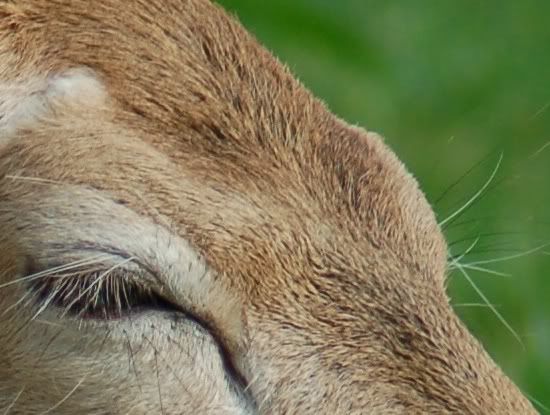
A sunday in Groenendaal parc, I had my Nikon Af 70-300/4.0-5.6 G in the camera bag and this deer (or is it a roebuck?) was lying there just inviting a shot. A lot of people write that the 70-300 g-type is soft at 300mm but I don't find this all that soft. OK, I had the aperture at 7.1 and that tends to help.
For those of you interested in this lens, here's a crop: http://i45.photobucket.com/albums/f81/wijnands/small_deer.jpg