This weekend I lend my D50 to my 4 year old son. This is one of the portraits he did with it. I think the boy has talent!
Thursday, October 26, 2006


Tuesday, October 17, 2006
Monday, October 16, 2006
A sunday in Groenendaal parc, I had my Nikon Af 70-300/4.0-5.6 G in the camera bag and this deer (or is it a roebuck?) was lying there just inviting a shot. A lot of people write that the 70-300 g-type is soft at 300mm but I don't find this all that soft. OK, I had the aperture at 7.1 and that tends to help.
For those of you interested in this lens, here's a crop: http://i45.photobucket.com/albums/f81/wijnands/small_deer.jpg

For those of you interested in this lens, here's a crop: http://i45.photobucket.com/albums/f81/wijnands/small_deer.jpg
Wednesday, October 11, 2006
Oops, we accidently deleted an OU
was the title of a high priority call that came in this morning. Now I knew that this client's infrastructure was connected by high-speed links so there was no chance of recovering the OU from a remote domain controller.
Being a MCSE I of course know the text-book solution to this, an authoritve restore and a lot of work with NTDSUtil. Not a job I was in the mood for this morning. So, after alerting the storage group to keep the tapes on hand I started looking for alternatives.
A quick google turned up KB article 840001 which outlines the procedure but I figured that by now there would be alternatives. The client's domain controllers weren't on SP1 yet so method 1 was out.
Reading that did remind me that objects that are deleted from Active Directory are not actually gone. Instead they are marked for deletion (tombstoned) but they are retained in active directory. I also read that it is possible with the LDP utility (ldp.exe from the support tools) to restore these objects. However using LDP for this is a rather time consuming process because you're manually editing properties for each object. So I figured someone else must have come across this already and that person would probably have written a clever little script for this tedious task.
Some more googling and I came across ADrestore from sysinternals. Now every admin knows that sysinternals makes excellent freeware so I figured I'd give that a shot.
Fired it up with adrestore -r laptops to restore the OU that was missing. OU restored in 3 seconds! Looked good so I did an adrestore -r nl-ams-lt to start restoring the computer accounts that were in the deleted ou. No luck! All the records had their LastKnownParent set to the Deleted Objects context.
Back to google and I quickly found Quest Software's Object Restore for Active Directory (registration required) which is a tool that does more or less the same only with a GUI. I noticed that the laptops OU was still listed as deleted. I restored it with that tool and tried to restore the computer accounts. Object restore crashed on me! So back to the command line and adrestore. This time the adrestore -r nl-ams-lt listed a lot of laptops with the correct lastKnownParent. Bingo! I quickly restored the 94 computer accounts and activated them.
Writing this I suspect that the admin who deleted the OU in the first place probably tried to save something by recreating the OU and that I restored that empty OU first.
Conclusion, to recover from an "oops" situation there are other options than booting in restore mode and messing with NTDSUtil.
Edit: This whole process would have worked a lot better if I'd remembered that unless you're in AD restore mode you can't restore passwords. So I had the computer accounts back but no passwords. Took a lot of tedious work with authorive restores to get that sorted.
The process I described here worked for me, however it may not work for you. Therefore this information is provided "as-is" with no warranty whatsoever. When working with Active Directory at this level the potential to do serious damage is great so be carefull and consider getting someone who knows what he/she is doing to assist you!
Monday, October 09, 2006
Manual Focus lens on a D50
Trickier than I thought. You're totally on your own, no metering, just the little green focus dot and that's not always correct.
Thanks to my years of experience with the Zenith EM I was able to get decent exposure after just a few shots. Took some more tries to get something decent. This was shot #21 with a 28-85mm f/3.5-4.5 AIS Manual Focus Lens I borrowed from a friend.
Lens does have a nice weight to it, about 450 grams which is heavier than my 70-300. Focussing is tricky, the area of the focus screen you need the most is taken up by the AF points. All in all a nice experience though. Should I happen to find a nice manual focus micro such as the 105mm for a decent price I'd be very tempted. This is the lens I used:

Friday, October 06, 2006
Photography
I started out on this hobby in the mid-80s. At that time I was really into planes and airshow and wanted to shoot pictures of that. After a very brief stint with a compact camera I saved some money from my newspaper round and bought myself a Zenith EM. Light meter above the lens and shutter times of only 1/500 but it takes M42 screw mount lenses. Back in the day there was a large supply of used lenses for decent prices. Good camera, I still have it and I can still shoot very decent pictures with it without consulting the built-in meter. Built like a tank too! I dropped it once and the only damage was to my foot which was between the camera and the floor.
Only drawback was the long time it took to change screw mount lenses. So I bought a Minolta, first an XG-1 and later an XG-9. Nice cameras and they performed well at airshows but I was always struggling to avoid over exposure. Sold the Xg-1 to my dad and recently sold the XG-9. Never did form any attachment to those.
Late 2000 I came across a hardly used Nikon F60 with an 28-80 for a very decent price so I bought that. Good camera, only the built-in flash was overly harsh. With that my love for Nikon really start. The built quality and ergonomics were so very good!
Around 2004 when my kids were toddlers I switched to digital. Digital cameras were rapidly getting better and cheaper and so I bought a Fuji A203. Very nice, very versatile, very bad shutter lag! Still I've captured some nice moments with it.
At that time dSLRs were becomming very nice and still very expensive. It wasn't untill the D50 and the Eos 350 (Rebel to the americans) were on the market that I could even begin to consider owning one.
This summer I got some lucky breaks and after long discussions with my wife I could actually go and get me one.
My Nikon D50!

I bought it, in black of course, with the 18-55DX kit lens. I still had the 28-80 d-type and that worked really well. After a trip to Blijdorp Zoo in Rotterdam I felt the need for a telezoom. I quickly bought a used Sigma 70-210 and almost as quickly regretted it. Fine lens but we never agreed. Just sold it via ebay and bought for only 90 euros an F55 with an 28-80 G-type and a 70-300G lens. Sold the body and the wide angle for 60, got another 30 for the Sigma so for the 80 euros I originally paid for the Sigma I now have a 70-300G type. Much better for me.
When you buy a nice camera like this and you start getting involved in Nikon forums it's easy to be overcome with "lens lust". I'm trying to resist that. Have to remind myself that I'm nowhere near the limits of my current selection of gear. My next goals are working on my post processing (or PP) skills and see what the manual focus lenses a friend will lend me will do on the camera.
I started out on this hobby in the mid-80s. At that time I was really into planes and airshow and wanted to shoot pictures of that. After a very brief stint with a compact camera I saved some money from my newspaper round and bought myself a Zenith EM. Light meter above the lens and shutter times of only 1/500 but it takes M42 screw mount lenses. Back in the day there was a large supply of used lenses for decent prices. Good camera, I still have it and I can still shoot very decent pictures with it without consulting the built-in meter. Built like a tank too! I dropped it once and the only damage was to my foot which was between the camera and the floor.
Only drawback was the long time it took to change screw mount lenses. So I bought a Minolta, first an XG-1 and later an XG-9. Nice cameras and they performed well at airshows but I was always struggling to avoid over exposure. Sold the Xg-1 to my dad and recently sold the XG-9. Never did form any attachment to those.
Late 2000 I came across a hardly used Nikon F60 with an 28-80 for a very decent price so I bought that. Good camera, only the built-in flash was overly harsh. With that my love for Nikon really start. The built quality and ergonomics were so very good!
Around 2004 when my kids were toddlers I switched to digital. Digital cameras were rapidly getting better and cheaper and so I bought a Fuji A203. Very nice, very versatile, very bad shutter lag! Still I've captured some nice moments with it.
At that time dSLRs were becomming very nice and still very expensive. It wasn't untill the D50 and the Eos 350 (Rebel to the americans) were on the market that I could even begin to consider owning one.
This summer I got some lucky breaks and after long discussions with my wife I could actually go and get me one.
My Nikon D50!
I bought it, in black of course, with the 18-55DX kit lens. I still had the 28-80 d-type and that worked really well. After a trip to Blijdorp Zoo in Rotterdam I felt the need for a telezoom. I quickly bought a used Sigma 70-210 and almost as quickly regretted it. Fine lens but we never agreed. Just sold it via ebay and bought for only 90 euros an F55 with an 28-80 G-type and a 70-300G lens. Sold the body and the wide angle for 60, got another 30 for the Sigma so for the 80 euros I originally paid for the Sigma I now have a 70-300G type. Much better for me.
When you buy a nice camera like this and you start getting involved in Nikon forums it's easy to be overcome with "lens lust". I'm trying to resist that. Have to remind myself that I'm nowhere near the limits of my current selection of gear. My next goals are working on my post processing (or PP) skills and see what the manual focus lenses a friend will lend me will do on the camera.
Thursday, October 05, 2006
Tuesday, October 03, 2006
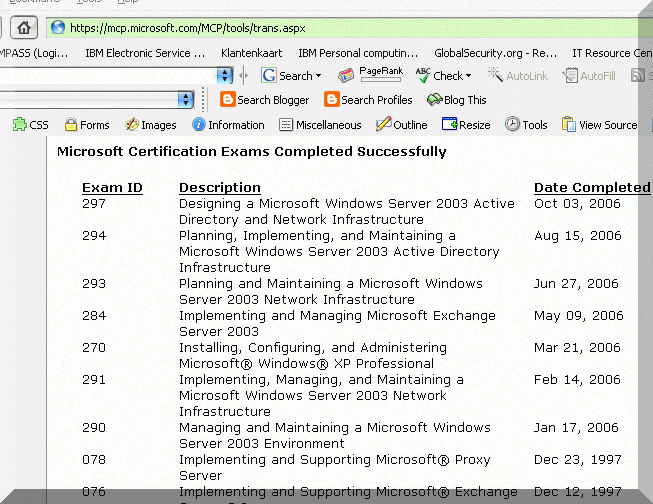
MCSE!!!!
Yep, I finally made it. This morning I sat and passed 70-297, Designing a Microsoft Windows Server 2003 Active Directory and Network Infrastructure. With the help of the self-paced training kit and a transcender CD I prepared for this exam.
During preparation I noticed that you shouldn't be fooled by the thin book. This exam requires knowledge from most of the previous exams (excluding XP and Exchange).
The form of the exam is a bit different that the previous exams. You get four scenarios with 10 questions each. The scenarios contain information about a company that will upgrade or migrate it's current IT infrastructure. To make it a bit more difficult the information you need is fragmented troughout business drivers, interviews, goals etc.
I've found that it helps to scroll trough all the question before moving to the next scenario. Most of the questions and answers have some relation with eachother.
It's difficult to give a study list for this one. You really need to know where to place things like WINS, DNS, DHCP, Domain controllers, VPN, etc, etc givven a certain set of variables.
One thing I'd suggest you memorize is what features the various domain levels bring (mixed mode, native mode, etc) and the differences feature wise between 2000 and 2003. When studying this focus on the administration parts of the differences.
Another suggestion, don't rely on this training kit alone for DNS. Go back to the other book and know exactly what's what with DNS!
Also make sure you know what a Windows 98 and NT client cannot do and a Windows 2000 or XP pro client can.
The transcender CD was useful to get used to the different exam style. In this exam it was more annoying than ever that the testing software doesn't support the scroll wheel on the mouse because you have a lot of reading to do.
For those of you who aren't as good with large amounts of information just make notes of the most relevant parts of the scenario information. When in doubt about two answers go back to the scenario and see if there's anything which will make the choice easier.
Thursday, September 14, 2006
ACommand Line SMTP Mailer for Windows is something that comes in handy from time to time. I stumbled across this one and found it excellent! A stand-alone executable of a mere 17kb and it does what needs to be done and nothing more than that. Highly reccomended!
A flying Me-262. I'd never thought that would happen but some crazy americans are actually building them again. Check out: Stormbirds
Sunday, September 10, 2006
Weber makes some very fine barbecues. Since my 33rd birthday a few weeks ago I'm the proud owner of a One-Touch Gold. Tried it out tonite and wow! That's grilling made very easy. My burgers tasted like ever before. The chimney starter makes it incredibly easy to get the thing started. 
Saturday, September 09, 2006
snapshot
My wife had bought herself a new cap (or perhaps a baret, I'm not sure). My son Bas also liked it a put it on. I was just in the garden to try and take a picture of a spider when I turned around and saw this. Had perhaps 2 seconds to take this shot so considering that it's not bad.
What I should have done is sit down, now his arm is cut of. Still, I'm pleased with this. Even the out of focus background turned out rather nice (bokeh?) and that with the humble 18-55 kit lens.

What I should have done is sit down, now his arm is cut of. Still, I'm pleased with this. Even the out of focus background turned out rather nice (bokeh?) and that with the humble 18-55 kit lens.
Friday, September 01, 2006

Moving day is tomorrow! Since we got the keys to our new house it's gone from "well, not much to do in the new place" to "and that needs painting, and that, and that...."
Most important bits are now wallpapered, painted or possibly both. Which is just in time because tomorrow I've rented a van, asked some friends to help out and we are going to move from this 2 bedroom appartment to a three bedroom house with a garden.
I'm curious to see if KPN will move my internet connection in time.
Sunday, August 20, 2006
Rhianne eating a muffin
is a pic I shot yesterday with my new D50. Since I got it I've been reading and posting in various photography forums. What amazes me is how easily amateur photographers discuss getting this 700eur or that 1100 euro lens.
OK, granted, there's some very nice optics on the market these days but why the **** does a hobby photographer need a 70-200/2.8 G AF-S VR IF ED (1800 euros) or a NIKON 17-55/2.8 G AF-S DX IF ED (1400 euros)???
OK, granted, perhaps I am a bit envious that I can't afford to spent that much money on my hobby. Since I can't I find that I'm more and more discovering and enjoying the challenge of doing nice work with inexpensive gear. Take this picture for example, it was shot with my current favourite, a 28-80mm f/3.5-5.6D which is a sub-100 euro lens.
I'm considering getting myself a 50mm 1.8 because of the 1.8 aperture. A 1,8 does allow for very extreme playing with out of focus areas.
Funny, 20 years ago you'd shoot with an f/8 or f/11 even and you'd be pleased to get your target properly focused. These days it's all about bokeh. Anyway, that 50mm is just sub-100 at 99 euros new. But perhaps the best thing to do is save my money untill I've had a few lessons of the photography course I signed up for. Then I may have a better idea of what lens would be the best investment.
Thursday, August 17, 2006
Logparser comes in handy once again!
I got a call this morning to have a look at a client's application server that has been misbehaving for the last few days. A quick glance learned me that from saturday until tuesday morning the application had sent out way too many emails. For the 4 period I had 1.3gb of IIS smtp logs.
Curious how many mails had been sent out exactly I copied the logs to my workstation and started logparser.
logparser "SELECT c-ip, COUNT(c-ip) FROM *.log WHERE cs-username =
'OutboundConnectionCommand' GROUP BY c-ip" -i:iisw3c -o:csv
Gave me a result which I'm still doubting. According to the query the server had sent out 4.3 million emails. During this time the server's cpu never spiked higher than 40%.
The recieving party wasn't totally ignorant either and took their own precautions so I'm now getting NDRs in a rate of about 60000/hour. Since this tends to eat up diskspace rather quickly I scheduled a script that cleans out the badmail every 10 minutes.
Tuesday, August 15, 2006
70-294 passed!
Yep, this morning I sat and passed 70-294 with a very reasonable 795 points. Not bad, especially considering the fact that I spent most of saturday night at the office sorting out an exchange problem, had my birthday party on sunday and we were too shorthanded at the office on monday to let me take my customary afternoon off to prep for the exam.
Anyway, the exam itself. First of all the title, Planning, Implementing, and Maintaining a Microsoft Windows Server 2003 Active Directory Infrastructure, is somewhat misleading. A better title would have been "Group policies in Windows 2003 and some other Active Directory subjects". No questions were very difficult or ambiguous. Out of the 39 questions, 5 of those were simulations by the way, 25 were about group policies quite a few of those were drag & drop type questions. Up until a month or two ago a lot of people would tell you that the simulations didn't count. You'd only get two or three of them at an exam. The fact that I got 5 on a 39 question exam leads me to believe they definitely count towards your score.
A lot of the other questions were about structuring your AD in a way that it allows a specific delegation of control scenario. Only a few were about AD replication issues, troubleshooting (answers involving AD restore mode are usually right). I've also seen three questions on the "your company bought another company and you need to setup trusts between the forests to accomplish XYZ".
I prepared for the exam with the official microsoft self paced kit:
 and a Transcender Cd. So, things to study
GPO concepts
Difference between computer and user policy
Software deployment with GPO
Troubleshooting GPOs
How to apply a GPO to a user or computer depending on OU, group membership or site.
How to delegate GPO administration
Everything else GPO related you can get your hands on
OU structures and delegation of control
Domain replication between site
Schema administration
Domain trusts (know what incomming and outgoing means, the term is used often on the exam and not much in the book)
AD disaster and fuck-up recovery.
That's pretty much it. Not one of the hardest exams. When you do them in sequence about 80% of what this exam covers should at the very least be vaguely familiar to you. If you want to setup a home lab for this you'd need at least two machines to experiment with GPOs. More if you want to try your hand at AD intersite operations.
That's it for this month, on the 23rd I'll finalize the purchase of my new house, the weeks after that will be full with moving and redecorating. My 70-297 exam is planned for the second of october. Until that time you can probably expect a lot of pics from my new Nikon D50.
Yep, this morning I sat and passed 70-294 with a very reasonable 795 points. Not bad, especially considering the fact that I spent most of saturday night at the office sorting out an exchange problem, had my birthday party on sunday and we were too shorthanded at the office on monday to let me take my customary afternoon off to prep for the exam.
Anyway, the exam itself. First of all the title, Planning, Implementing, and Maintaining a Microsoft Windows Server 2003 Active Directory Infrastructure, is somewhat misleading. A better title would have been "Group policies in Windows 2003 and some other Active Directory subjects". No questions were very difficult or ambiguous. Out of the 39 questions, 5 of those were simulations by the way, 25 were about group policies quite a few of those were drag & drop type questions. Up until a month or two ago a lot of people would tell you that the simulations didn't count. You'd only get two or three of them at an exam. The fact that I got 5 on a 39 question exam leads me to believe they definitely count towards your score.
A lot of the other questions were about structuring your AD in a way that it allows a specific delegation of control scenario. Only a few were about AD replication issues, troubleshooting (answers involving AD restore mode are usually right). I've also seen three questions on the "your company bought another company and you need to setup trusts between the forests to accomplish XYZ".
I prepared for the exam with the official microsoft self paced kit:
and a Transcender Cd. So, things to studyGPO concepts
Difference between computer and user policy
Software deployment with GPO
Troubleshooting GPOs
How to apply a GPO to a user or computer depending on OU, group membership or site.
How to delegate GPO administration
Everything else GPO related you can get your hands on
OU structures and delegation of control
Domain replication between site
Schema administration
Domain trusts (know what incomming and outgoing means, the term is used often on the exam and not much in the book)
AD disaster and fuck-up recovery.
That's pretty much it. Not one of the hardest exams. When you do them in sequence about 80% of what this exam covers should at the very least be vaguely familiar to you. If you want to setup a home lab for this you'd need at least two machines to experiment with GPOs. More if you want to try your hand at AD intersite operations.
That's it for this month, on the 23rd I'll finalize the purchase of my new house, the weeks after that will be full with moving and redecorating. My 70-297 exam is planned for the second of october. Until that time you can probably expect a lot of pics from my new Nikon D50.
Wednesday, August 02, 2006
Enumerate the list of installed Hotfixes using WMI
Shows a very simple way to display all hotfixes installed on a machine.
Just do a wmic qfe list full /format:htable>c:\somefile.htm and you'll end up with a nicely formatted list of hotfixes.
Shows a very simple way to display all hotfixes installed on a machine.
Just do a wmic qfe list full /format:htable>c:\somefile.htm and you'll end up with a nicely formatted list of hotfixes.
Friday, July 28, 2006
DSC_0443
Some sort of Butterfly sitting on an orchid. Taken at Blijdorp Zoo with an old 28-80 zoom. Not bad considering the lens I was using.
Here's how I did it:

Here's how I did it:
| Camera: | Nikon D50 |
| Exposure: | 0.003 sec (1/320) |
| Aperture: | f/5.6 |
| Focal Length: | 80 mm |
| Exposure Bias: | 0/6 EV |
| ISO Speed: | 800 |
Tuesday, July 25, 2006
I've taken a week vacation. The kids also don't have to go to school so we've got the time to do fun things with the kids. And I got time to try out my new D50!
I'm also skipping class this week so that means a lot of reading next week to catch up. I get the feeling 70-294 may me more difficult than it seems at first.
I'm also skipping class this week so that means a lot of reading next week to catch up. I get the feeling 70-294 may me more difficult than it seems at first.
Monday, July 24, 2006
DSC_0470
Renkoekoek aka RoadRunner in the Blijdorp zoo. Having a white mouse for it's afternoon tea.


Subscribe to:
Posts (Atom)