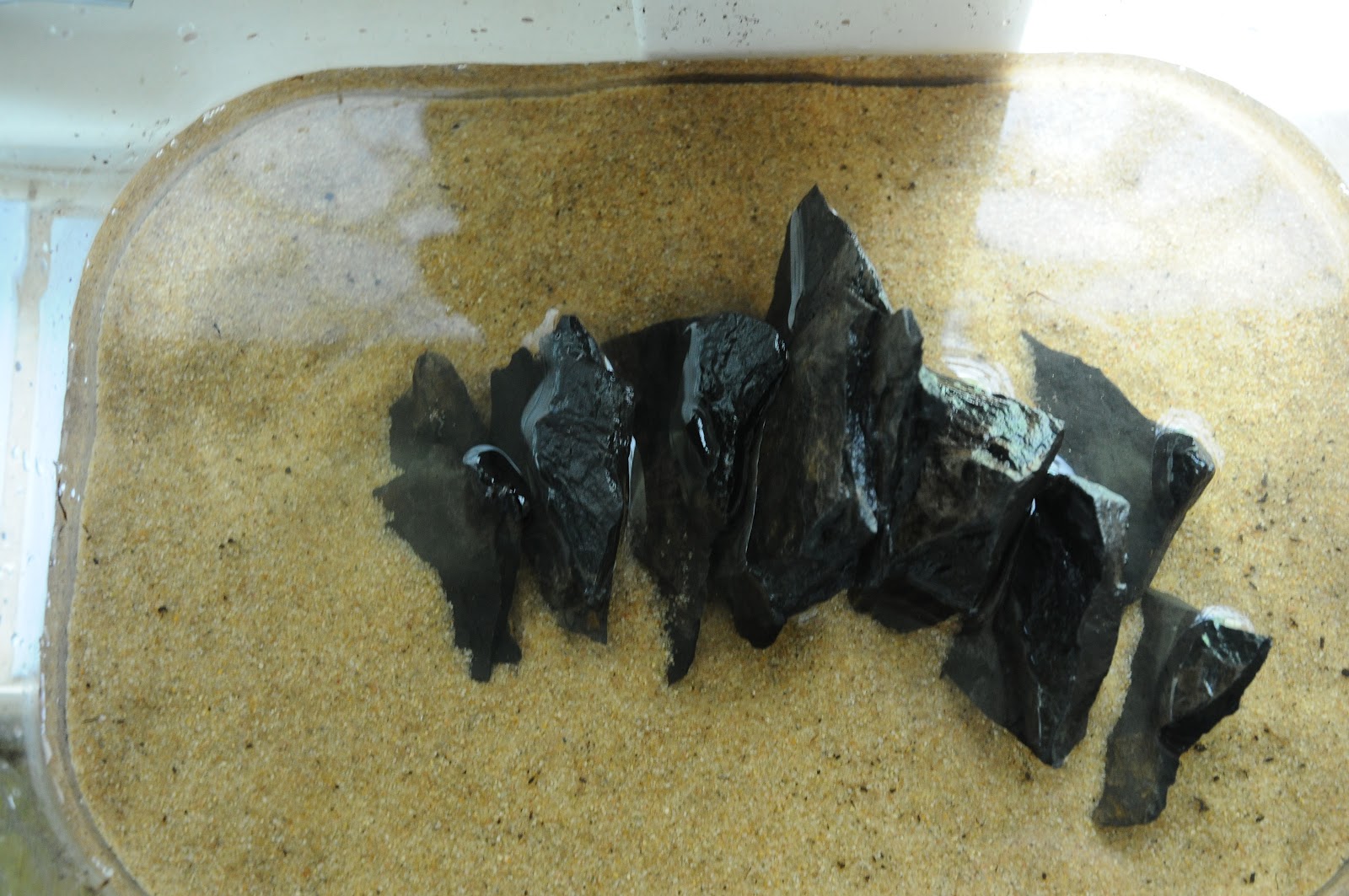
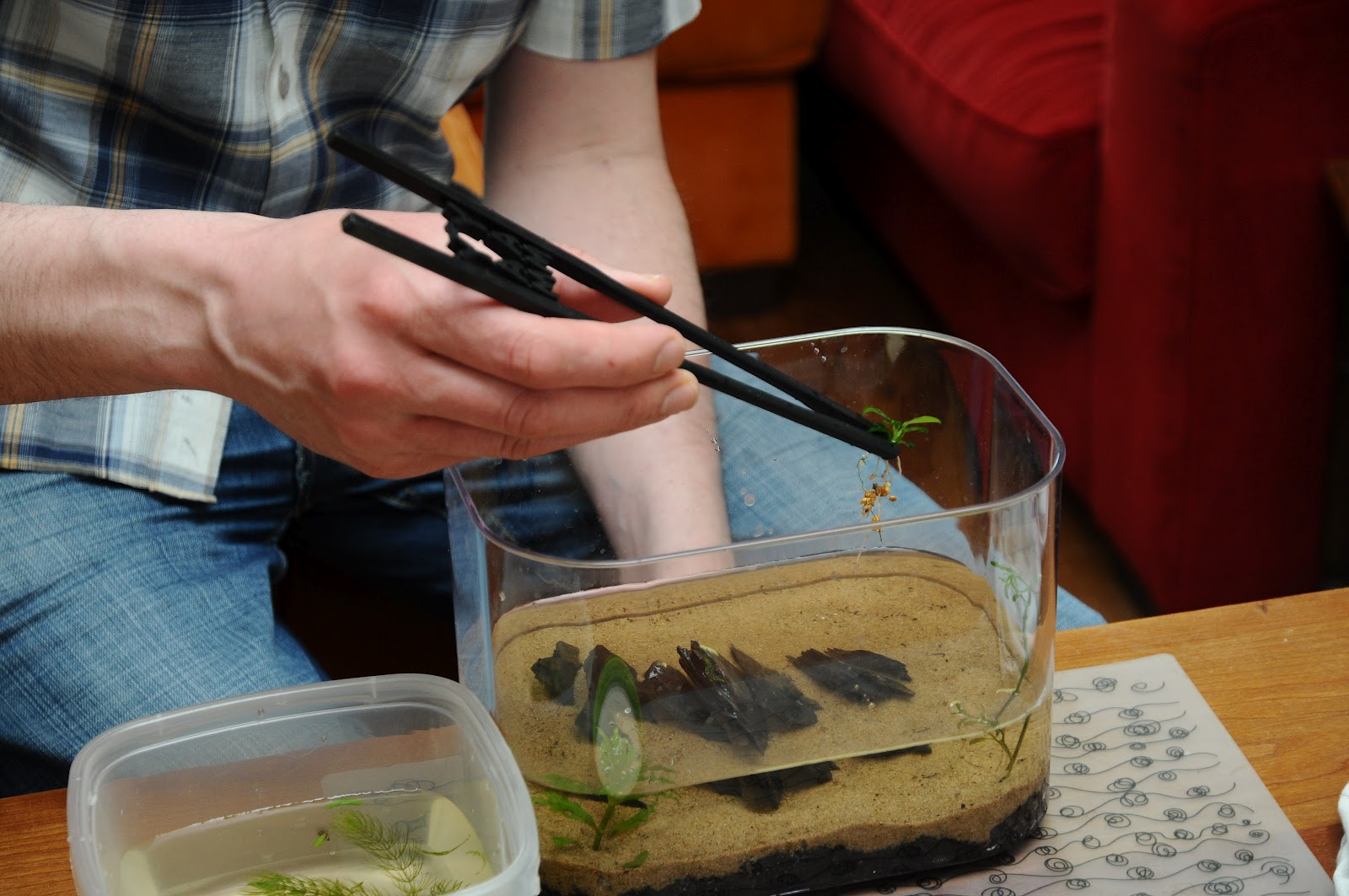
After 4 days it shows the difference. Everything is growing more upright and the Echindorus is now sending out it's first runners. The plants are doing better now, table still isn't stable enough
Aquarium, Nikon D300, Photography, family, kids, work, whatever else keeps me busy.
Friday, June 22, 2012
1 gallon gets lighted
After 4 days it shows the difference. Everything is growing more upright and the Echindorus is now sending out it's first runners. The plants are doing better now, table still isn't stable enough
Wednesday, June 06, 2012
bamboo sticks in trouble
I'll keep my eyes open for some suitable driftwood sticks.
Saturday, May 26, 2012
4.5 liter / 1 gallon planted tank makeover
Plantwise, Pogostemon Helferi did surprisingly well. It was a bit less brilliant green and growth was slow but it had obviously taken. Hygrophila polysperma of which I was really worried last week has recovered and is slowly growing.The tiny anubias, which was a bit dodgy to begin with, wasn't working out all that well. I suspect these guys need a bit more light.
Now I'd read Diana's piece on shrimp bowls as well as a few other odds and ends and she always speaks highly of Echinodorus tenellus and likes Rotala rotundifolia as well. I read up on E. Tenellus and suspect it might do very well as a filler plant. I think it is going to form a dense forest quite easily.
I ended up ordering 3 pots of Echinodorus Tenellus and 1 pot of Rotala Rotundifolia for the grand total of 11 euros and 40 cents. For plants I've recently switched to aquaplantsonline.nl. Good plants at very decent prices. To prepare for the work I took the tank from it's place, drained 60% of the water and put it on the plastic IKEA serving tray I use for these jobs (easy to clean and keeps the table spotless).
E. Tellus:
Three shotglass sized plastic pots filled with rockwool. Obviously well rooted which is something I like to see when I buy plants. The one on the right was even flowering. Now, as most readers will know, when they arrive like this they're not suited to plant. In the pots they look terrible and if you plant them with the rockwool attached they'll take forever to settle in and spread. So, some disassembly is required:
Remove the pot and you see what you need to remove while damaging the roots as little as possible. Take note of what emerges above "ground"level, that's how they need to be planted. What works best is first work around the outside, pick of what goes easy. Then take a good look and see how many strands you have. Divide and pick the strands clean.
I ended up with 10 strands of E. Tellus out of 3 pots.
Rotala rotundifolia was more or less the same story only this plant doesn't do strands but has a more bush-like growth. Once again, pick it clean and take a good look. I decided to tear the bush in three and plant it out. After this I refilled the tank, put it back in it's place and let it settle. When you've done work it's tempting to grab the camera immediately. Bad idea, the water's likely to be cloudy and the plants need to find their positions.
In the back E.Tellus. Front left you can just see the curly leafs of a small Pogostemon Helferi and behind it the round leaves of Rotala Rotundifolia. Sticking out of the water on the left is a E. Tellus flower.
In a day or so I'll try to do a few overview shots and maybe a drawing of how I set it up. The curved walls make it difficult to do a good frontal overview shot.
Friday, May 25, 2012
Some odds and ends from the web
An interesting article by Heiko Bleher looking at some tiny species from South America.
Tropicalfishfinder has an overview of sub-tropical and tiny rice fish from Asia.
Aquascapetv has some pictures from Interzoo 2012 on facebook. I'm still looking for a decent show report though.
Saturday, May 19, 2012
4.5 liter / 1 gallon planted tank day 7
I've trimmed down the willow moss quite a bit, removed a few strings of algae and rubbed the glass clean.
The anubias seems to take, it's forming a new leaf. Cabomba, strangely enough, is very slow to take. Pogostemon helferi has taken but grows very slowly. Strangely enough Hygrophila polysperma seems to be dying, never done that to me before.
I think there's potential in this setup but I need to adjust the plants. Echinodorus tenellus and Sagittaria subulata have a lot of potential since they're marshy subtropical plants. I see no need to add any additional equipment to this set.
Wednesday, May 16, 2012
Quick update on the big aquarium
The shrimp went absolutely crazy over them. Within minutes they were exploring every pore of the leaves. Soon after followed the snails.
I also took an overview picture. Plantwise I'm now quite happy with the looks.
Story about my big aquarium
Eventually I quit that a few years later.
Around the turn of the century the aquarium virus struck again. I used my Y2K bonus to buy a Juwel Rekord 60, the basic tank from the well known German manufacturer. Built in filter, hood with a single tube. Biggest setback came around 2004 when fish TB hit my tank. I'd dealt with that when a move wiped out most of my remaining stocks.
In 2006 I rebuilt and used a fine white gravel, tiny pellets, looked good. For the first time I had real and unexplainable problems. My plants did fine, the shrimp I got from a friend reproduced like rabbits and yet the tetras and aspidoras never did well. Tried everything I knew and never could get rid of the sky high hardness and PH. I gave up for a while and took care of the survivors as best as I could.
In late 2011 I finally had some more time and decided to solve the problem. Turned out that fine white gravel was almost pure calcium. I put some in strong vinegar solution and found it was almost pure calcium, it totally dissolved in 72 hours. March 2012 saw the third build since I'd bought the tank. This time I went for quality materials. Dekoline gravel which is fine quartz coated in a thin layer of some kind of resin to make it inert and allow roots better grip. I retained most plants including a nice looking piece of driftwood which I started covering with anubias two years earlier and which is totally covered by now.
The left side of the tank is taken up by Hygrophila Corymbosa which I bought from Ikea for 2 euros. Simple, grows well, when it gets too tall I chop the top of and plant it again.
Back right is Ceratopteris thalictroides. Lovely plant, stuck in in to camouflage the built-in filter. It grows extremely well! In front of the filter my willow moss covered bamboo sticks. Recently my micro rasboras (mix of brigittae and merah) have taken to hanging around there.
Tuesday, May 15, 2012
4.5 liter / 1 gallon planted tank day 3
As you can see it drops significantly over the night. On the first day I had some bright sun directly on the tank which really heated things up. Looks like I'll have to find a different spot for it out of direct sunlight.
The plants themselves may be taking. The anubias is looking scruffy but I'm hoping it bounces back. The willow moss is pumping out O2 bubbles like crazy. I'm a bit worried about that one stealing everyone's CO2.
Tech for tiny tanks
As soon as you move below 20 liters the choices in equipment become really limited. There's a very few internal filters but even those would take up 20-30% of my space.
Superfish makes the aqua 50 which they sell with their small tanks. At about 8 euros it's a good deal. Most people who keep tanks this small just stick a sponge filter in. Problem there is to find an air pump that's silent.
Heating is even more tricky. And here your choices get really limited. At 14 cm for an adjustable 10 watts of power the Aquarium Systems Newattino is the smallest choice. Retails for about 15 euros.
I'm relocating it tomorrow and doing the first water change.
Monday, May 14, 2012
4.5 liter / 1 gallon planted tank day 2
I've got the lid on it on a few spacers to allow for gas exchange.
What's in here:
- Fontinalis antipyretica (willow moss)
- Pogostemon Helferi
- Anubias Nana
- Cabomba aquatica
- Hygrophila Polysperma
- two unidentified plants
I've lodged the cambomba and the willow moss under a pebble, see if it will take root
After an hour or so of sunlight the willow moss was really pumping out the oxygen. I've kept a close eye on the thermometer, it topped out at 27 degrees C.
Once again, this isn't intended to look nice (yet) but to gain experience, see what will work and what will not.
Todo for the next week
- Daily temperature readings
- Keeping an eye out for algae
- See how many snails I've accidently transfered
- Syphon away the pieces of dirt that some escaped and mess up the looks of the sand.
4.5 liter / 1 gallon planted tank
The tank
I've read all sorts of experiments featuring pickle jars. Unfortunately over here finding such a jar is difficult and what jars I looked at where made of very high tension glass, often with loads of distortions as well. So, in the end I settled for a plastic storage container, the rosti-mepal Modula "Jumbo"
4500 ml of clear acrylic storage solution.
After buying that I've done all sorts of reading on further tech for these pico aquariums. There's some internal filter solutions but even the smallest would take a hefty chunk out of my budget and available space. Heaters, I'll get to heaters in a next episode, let's just say there's not much choice.
On one of my walks I'd found some slate, probably from a torn down building which was used to stabilize a path. After a failed experiment to wash and sieve some old paving sand I gave up and bought a 2.5kg bag of VDL river sand.
Setting it up
I've read a ton of resources and found the best looking nanos and picos are all CO2 supported and a lot of the good ones look alike. I'm not entirely sure if I want to participate inthat.
One of the things I did read was a few pages written by the legendary Diana Walstad on a low tech shrimp bowl.
Inspired by this I've taken a mixture of 75% potting soil and 25% river clay which is what most of this area where I live is made of anyway.
Pic shot before I fished the root bits out.
Now I washed the sand a few times to get the last bits of dust out. Applied it and stuck in the slate.
I added some water and left it all to settle overnight.
The next day was maintenance day on my aquarium anyway. I took some cuttings of various plants and some tank water in which I rinsed out my ceramic filter medium.
Plating in something this small isn't easy. Some old trainer chopsticks do help:
Wednesday, May 09, 2012
My Trigonostigma Hengeli turns out to be Trigonostigma espei
Difference isn't stellar, Espei is a bit more coloured and comes from Thailand and Cambodia, not from Indonesia like Hengeli. Fortunately their needs in water quality are almost identical. These are blackwater species, water in forest where all sorts of things drop into the water and decay which gives tannin rich water, slightly acidic and rather soft. I replicate that with alder catkins and some oak leaves.
Once again it shows that you can't really trust the shop's identification.
Still really like these fish though, they've got personality, are kind to the small rasboras and they absolutely love peas! Soon I'll have the first batch of mosquito larvae to feed, wonder how they will react to those.
Tuesday, May 08, 2012
Bamboo sticks a few days later
What you see here is more than 3 centimetres of fresh moss. Pretty amazing in just a few days. A bit more overview to show it's not a single strand.
Friday, May 04, 2012
Introducing bamboo sticks
So I decided to create my own version. In this country bamboo sticks are sold in garden centers as plant supports. The cheap ones aren't even treated with anything. I had some lying around in the garden unused for months. Continuous rain and some frost had weathered them nicely. I cut them down to size and drilled some 2mm holes to aid in water absorption. Rinse a few times with boiling water and leave them to soak for a few hours.
Now mosses are a relatively new addition to the aquarium hobby, many were introduced by the aquascaping community and the legendary Takashi Amano. Dennerle went for java moss because it sticks easy to objects and it tolerates tropical conditions well. I went for willow moss (Fontinalis antipyretica) because it's grows abundantly in my dad's pond. Using any kind of plant from a pond is always a risk because you never know if you introduce any critters that way. To mitigate that risk I rinsed the moss well 6 times with cold tap water.
I divided the moss into portions and wrapped and twisted it around the sticks using 0.25mm fishing line to keep it on the sticks. Some people use cotton because it will eventually rot away, I use fishing line because it's invisible if you take care to trim the ends away. In wrapping I kept the ends free because these went into the bottom.
The sticks are intended to hide the big juwel filter box in the corner of my aquarium. That may be a bonus for the moss since it likes flowing water. My tank runs at 23.5 degrees which should be acceptable to the willow moss (go over 25 and the cold water raised variety will wither away).
I planted the sticks and immediately the shrimp went nuts over it and are swarming all over picking off all sorts of particles. It's early to tell if this experiment will succeed but this morning I saw the first bright green tips already so it seems to be growing.
And an overview shot:
Saturday, April 28, 2012
Bought some new plants today.
Pogostemon Helferi. The first should grow and fill the right back of the tank. The second is a somewhat hyped foreground plant from Thailand.
I'll just have to wait and see how these do in my aquarium, too early to tell now.
Oh, and I got these plants here:
Wednesday, April 25, 2012
my aquarium
I'm not entirely happy with it yet, the Hygrophila polysperma in the front right requires almost constant pruning and I want something long but not massive for the back right. Was thinking valisneria but somehow I've never had much success with these.
Wednesday, April 18, 2012
Pretty good stuff really. When you have a lot of shrimp like I do just break one of these in four and an hour later it's all gone.
One of the fun things to watch is what happens when the shrimp smell the food, they will litteraly walk over each other to get to it. It's also not unusual to see two or three shrimp do a tug-of-war over a small scrap.
Since the recent overhaul of my Juwel 60-ish liter aquarium I've once again become fascinated by the idea of a second aquarium. Unfortunately I do not have the room for a second full size tank and even finding a spot for a small extra tank will be a challenge.
Recently the nano and even pico aquarium has gained a lot of popularity. There's an ample supply of 10 and 20 liter setups two of which have caught my attention.
Aquael Shrimp Set 20
Superfish Aqua-Qubie 25
Both are roughly similar in dimensions, both feature a tiny filter and heater. The Aquael has an 11 watt PL light which is typical for tanks in this class, the superfish is one of the first that features a LED light of about 3 watts power consumption.
Of course there's also plenty of more conventional rectangular aquariums in the 25 liter class.
Then there's another class, the pico aquarium. Slobodan Lazarevic is a master of the subject as you can see here:
A dream in just 2 liters!
There's various other things of course like a pickle jar.
Practical fishkeeping (lovely magazine) has some good information on planting a small tank.
Recently I did a big tank overhaul. Once that had finished and settled I started looking for some new tank mates for my 54 liter tank. It's planted and features an anubias covered piece of wood as it's centerpiece. The tank was inhabited at that time by 3 Boraras brigittae, a lonely golden tetra and a large number of shrimp. It's filtered by the standard juwel filter setup.
I started looking for some more brigittae to bring the school back to a decent size again. Bit of research showed me there's a few species that are largely similar.
Boraras brigittae
Boraras brigittae - Mosquito Rasbora by j_wijnands, on Flickr
Boraras merah
These are Indonesian and largely similar.
A bit further up in south east Asia we find Boraras Maculatus. Some source list this as Mainland only especially the Malay peninsula but other sources claim it's also found in Sumatra.
Boraras maculatus by Chantal Wagner, on Flickr
http://www.fishbase.org/summary/Boraras-maculatus.html
Further to the west still in Thailand and Vietnam there's Boraras urophthalmoides
Boraras urophthalmoides by swordw, on Flickr
Now the latter I've never seen in shops here in the Netherlands but the first three are available but not all that common. These fish are also mislabled extremely often!
All of these species have a few things in common first and most apparant is of course their size. These fish are tiny! A hefty adult female could measure a whopping 22mm, literature lists 25mm as maximum. They're also found in somewhat similar conditions, heavy planted streams in the forest. Lighting is dim and there's loads of leaf litter and other debris on the bottom.
Once my tank stabilised I bought a school of 10 merah because I just could not get any Brigittae within a 50km radius of where I live. Followed the standard introduction technique and to my intense relieve the merah immediately hooked up with the remaining brigittae.
Over the first week I've lost 2 of the 10 to unknown causes. With a good shrimp population dead fish just disappear.
They seemed to do well, the school falling apart in 3 groups when hunting for food but immediately hooking up again if they thought there was any danger. Seeing these little guys drift just below the surface waiting for any insects is great fun, they really seem to think they're jaws!
One of the male merah has developed a strange fixation with the left wall of the tank, it's constantly fighting it's own reflection. Two others have joined up with a brigittae and can often be seen hunting in the dense population on the edges of the tank.
Things really perked up after I introduced a dose of peat to my filter. As the water coloured the fish perked up. They're now displaying full colours all the time, not just at meal times and some are now making overtures to the females of the group.
A happy brigittae especially can be really quite colourful as you can see
Additionally I got 6 rasbora Hengeli or Trigonostigma hengeli as they're known since 1999. Most people will know this as a small fish but compared to the boraras species it's positively huge!
My store had a mix of adult females and somewhat younger males. The smallest of which is here next to a merah
The adult females are almost twice as big.
Hengeli comes also from Indonesia but a bit more towards the eastern islands. Even though they don't seem to mind the difference. It's a more active and noticeable species than their tiny tankmates but they do get along well. Old eeyore the tetra hooked up with them, is happy once again and even had a brief romantic interlude with one of the younger male hengeli
The Hengeli also seem to appreciate the addition of peat, they're now flying full colours almost all the time.
Feeding these is easy, they take the staple of Tetramin flakes easily but I do have to grind half the flakes rather fine between my fingers otherwise it's just too big for the boraras. I've also fed TetraFreshDelica Brine Shrimps. Which they take too when it's moved around by the filter but otherwise don't really care for too much. Pretty soon the weather will heat up here and I will see how they react to fresh mosquito larvae.
All of these are absolutely safe for adult shrimp, apart from an occasional attempt to steal food from a shrimp they leave each other alone. In my opinion the boraras could make a nice addition to a well planted aquascape. Do keep them in groups of at least 8 otherwise they will act skittish.
Sunday, March 25, 2012
After figuring out that the fine white gravel I got on the bottom of the tank was the most likely cause for continuously high PH and KH values I decided it was time to do a major overhaul.
Is what I had on the bottom. After some serious head scratching I decided to test it. Put it into some vinegar and after 72 hours it was completely dissolved.
So, time for something new. I bought a bucket of Dennerle Deponitmix
Which I know is long lasting and shrimp compatible. I also got two bags of Dekoline quartz . The dekoline quartz is obviously quality stuff. Contains very little dust and no debris whatsoever. Easy to work with. Just to check I put some into vinegar as well and after 72 hours it was completely inert.
So, d-day. Got some buckets ready and a big tub for the plants. Filled one with water from the tank and spent considerable time catching every little shrimp. Even found some in the filter who'd been without water for at least 15 minutes and who happily wriggled away again.
Four hours later I'd removed the old gravel, rinsed out the tank somewhat, poured the new substrate and gravel and replanted the tank. I've decided to give the Hygrophila polysperma one final chance. Planted a dense clump of it. If that doesn't work I'm going to replace it.
aquarium by j_wijnands, on Flickr
For the next week at least I'm not even going to touch it, just see if the water values stabilize. After that I'm going to do a phased restocking.
Tuesday, August 16, 2011
Yes, I am fully aware that many people advise never to save on a tripod. I know Thom Hogan wrote a good piece on the subject. http://www.bythom.com/support.htm
However, I just didn't have a $1000 to spend on a tripod and I really wanted one anyway. I decided to look at the budget end of the market and see if I could find something useable for less than a 100 euros.
I like calumet as a shop. Unlike some other bigger shops in my country the staff are friendly, know their stuff and aren't pushy. When I got a monopod I topped it of with a calumet head. That's since outlasted the monopod. So, when I went looking for a tripod I remembered calumet's own brand.
When I googled I mainly found people asking questions about this, not many sharing opinions so here's a first look. This is going on vacation with me for some field testing, I will update after that.
Other options in this price range are Velbon, which is nice enough. In fact I was using my dad's old tripod which dates back to the days when aluminum was a novelty and which seems to be made of parts left over from some cold war warplane. Other options include hama and cullman (seem to be identical) and various other noname brands none of which really appealed to me.
So, I went for the calumet 7300.
It can extend high enough that I hardly have to stoop to look trough the viewfinder (and I'm 2 meters tall)
For extremely low shooting you can remove the bottom bit of the central pillar.
The head is a simple but well made 3-way:
Which includes a tiny spirit level. Controls are simple but well constructed.
The tripod is able to support a d300 + sigma 150-500 without getting wobbly (unless it's windy)
Pulling up on these clamps with calumet cast into them allows you to spread the legs further. You have a choice of 3 positions.
When you get it as low as this it gets a bit bouncy. Sliding the legs in helps with that but it's not able to provide the level of support the serious birders get from their gitzo tripods
The whole tripod weighs in at about 2600 grams and comes with a 3 year warranty. I don't think it's an excellent tripod but I do think it offers very good value for money. At a price where you'd struggle to find a basic set of Manfrotto legs you get a capable, no-frills tripod. To my mind it does show that budget tripods are not all bad.